- Affordable web design must offer genuine value — including ownership, SEO, and sector-specific features.
- Many low-cost options hide fees and ownership traps that become costly long-term.
Cheap does not always mean cheerful, especially when your website is the first thing a potential customer sees. Many tradespeople and small business owners across the UK have been burned by web design packages that looked affordable on the surface but quietly drained time, money, and opportunity. This guide cuts through the noise to show you exactly what affordable web design should deliver, what traps to avoid, and how to make a smart investment that actually brings in local work.
Table of Contents
Key Takeaways
Know true affordability
Affordable web design should balance price, ownership, and necessary features for your business.
Avoid common pitfalls
Watch out for hidden fees and ownership traps in DIY or low-cost packages.
Set clear expectations
Ensure any designer provides clear deliverables, local SEO, and reliable support in the price.
Focus on your needs
Tailor your web design investment to your business size, sector, and local competition.
What does affordable web design really mean?
The word "affordable" gets thrown around constantly in web design, but it rarely comes with a clear definition. For a plumber in Leeds or a cleaning company in Sheffield, affordable means something very different from what it means to a marketing agency in central London. True affordability is about getting genuine value for your money, not just paying the lowest number on a quote.
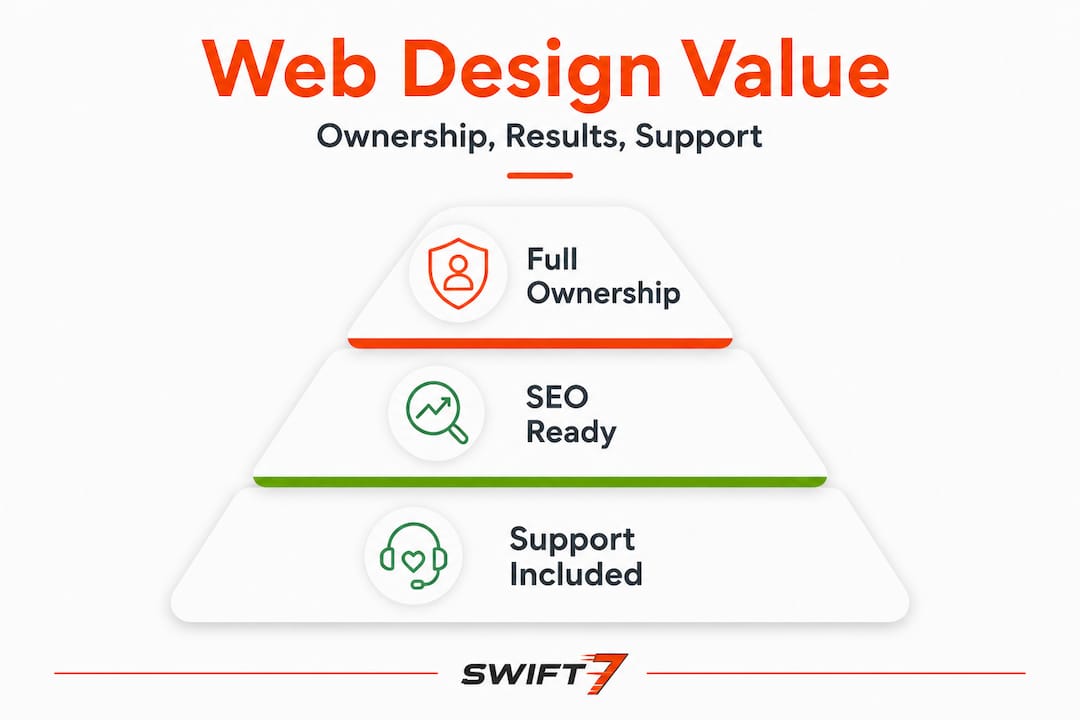
In practical terms, an affordable web design package for a UK small business should include your domain name setup, hosting, an SSL certificate, a mobile-friendly design, and at least the basics of on-page SEO. If any of those are missing or charged as extras, the package is not as affordable as it first appears.
Typical UK price brackets for small business web design:
| Tier | Price range | What you typically get |
|---|---|---|
| Budget | £300–£800 | Template site, limited pages, minimal support |
| Mid-range | £800–£2,500 | Custom design, SEO basics, mobile-friendly |
| Professional | £2,500–£5,000+ | Full SEO, content, ongoing support, local strategy |
For tradespeople, the sweet spot is usually the mid-range bracket, provided the package genuinely includes what it claims. A builder or electrician does not need a complex e-commerce platform. They need a clean, fast, credible site that shows up when someone searches locally.
- Look for a clear list of deliverables before you sign anything
- Confirm you will own the domain and the website files outright
- Check whether support is included or charged separately
- Ask specifically about mobile optimisation and local SEO setup
Providers who build web design for builders or web design for electricians often understand the specific pages and calls to action that convert local visitors into enquiries — which a generic designer may miss entirely.
Never judge a web design package on price alone. A £500 site that you own outright and that ranks locally is worth ten times more than a £300 site that locks you into monthly fees and gives you no SEO foundation.
Common traps: when 'affordable' becomes expensive
The web design industry is full of options that look affordable at first glance but quietly cost you far more over time. Understanding these traps before you spend a penny could save you hundreds of pounds and months of frustration.
The DIY builder trap
Platforms like Wix, Squarespace, and similar tools market themselves heavily to small businesses. The entry price looks attractive. But hidden fees and subscription costs add up fast. You often need to upgrade to remove adverts, connect a custom domain, or use basic SEO tools. What started as free can easily reach £200–£400 per year, and you are still doing all the work yourself.
The ownership problem
This is the trap that causes the most long-term damage. When you build a site on a proprietary platform, you do not truly own it. If you stop paying, your site disappears. If the platform changes its pricing or shuts down, you have no recourse. A proper web design service should give you full ownership of both your domain and your website files.
The SEO black hole
Many budget packages offer very limited SEO capabilities. For a cleaning company in Bradford or a removal firm in Manchester, local SEO is not a luxury. It is the difference between appearing on the first page of Google and being invisible.
"Businesses in competitive areas often need to invest £3,000 or more just to have a realistic chance of ranking on Google."
The hidden cost checklist:
- Monthly or annual platform subscription fees
- Fees to connect your own domain name
- Charges to remove platform branding
- Paid add-ons for contact forms or booking tools
- Extra costs for SSL certificates
- Fees to make basic edits or update content
- Support charges billed per hour with no cap
Sector-specific providers for services like web design for cleaning companies and web design for removal companies tend to be more transparent about pricing because they work with the same type of client repeatedly.
What you should expect from an affordable web designer
A trustworthy, affordable web designer will be upfront about everything. Here is what good looks like:
Essential things a good affordable package must include:
- Full ownership of your domain name and website files
- Mobile-friendly, responsive design that works on phones and tablets
- On-page SEO basics: title tags, meta descriptions, header structure
- A contact form and clear calls to action on every key page
- Google Business Profile setup or guidance
- SSL certificate included as standard
- A clear, written breakdown of what is and is not included
- A realistic timeline with milestones
Warning signs to watch for:
- Vague timelines with no firm delivery date
- Contracts that lock you in for 12 months or more without clear exit terms
- Essential features listed as paid add-ons
- No examples of past work for small businesses or trades clients
- Promises of "guaranteed number one on Google" (nobody can guarantee this)
Before committing to any web designer, ask to see three examples of websites they have built for tradespeople or local service businesses. Ask how those sites perform in local search. A good designer will be proud to share results.
Specialist providers who focus on sectors like web design for roofers and web design for plumbers already know the content structure, trust signals, and local SEO elements that work for those trades.
Making affordable web design work for your business
Here is a straightforward process you can follow to get a professional website live without overspending or overcomplicating things.
- Set a realistic budget. For most trades and small service businesses, £500–£1,500 is a reasonable starting point for a proper, owned website with SEO basics included.
- List your business priorities. Do you need a booking form? A gallery of past work? Customer reviews? Write down the five most important things your website must do.
- Gather your assets. Collect your logo, photos of your work, any existing customer testimonials, and your contact details. Having these ready speeds up the build dramatically.
- Research local and specialist providers. Look at their portfolio. Read their Google reviews.
- Request written quotes with itemised breakdowns. Compare what is actually included, not just the headline price.
- Confirm ownership terms in writing before any money changes hands.
Local SEO deserves special attention. Make sure your website includes your town or city name in key places: the page title, the main heading, and the body text. If you serve multiple areas, consider individual location pages. For a landscaper covering several towns, a provider offering web design for landscapers with built-in local SEO structure can make a significant difference to visibility.
Focus first on getting a professional, credible homepage live as quickly as possible. A single well-optimised page that ranks locally will generate more business than a ten-page site that takes six months to launch and never appears in search results.
Why most 'affordable web design' advice misses the mark
Most guides on this subject are essentially long lists of features followed by a price comparison table. That misses the deeper issue entirely.
The real question is not "what is the cheapest option?" It is "what is the most cost-effective investment for my specific business situation?" Those are very different questions, and confusing them is how small business owners end up with websites that cost them money rather than making them money.
The businesses that get this right share a few common traits. They treat their website as a business asset, not a box-ticking exercise. They ask the right questions before signing. They choose providers with genuine experience in their sector. And they invest a little more upfront to avoid paying far more later.
True affordability is about ownership, results, and ongoing value. A website that you own outright, that loads quickly on mobile, that ranks for local searches, and that converts visitors into enquiries is affordable at almost any reasonable price point. A website that does none of those things is expensive at any price.
Frequently asked questions
What are common hidden fees in affordable web design?
Extras like compulsory subscriptions, paid email, hosting charges, support fees, or costs to make basic edits are among the most common hidden fees to watch for when comparing packages.
How much does small business web design cost in the UK?
Prices typically range from £500 to £3,000 or more depending on complexity, with London costs running 30 to 50% higher than the national average for comparable work.
Do I own my website if I use a cheap website builder?
Often you do not. Platforms like Wix impose ownership and SEO limits that mean you cannot fully control your site or move it freely if you stop paying.
What makes a web design package genuinely affordable?
Genuine affordability means full ownership, clear deliverables, mobile optimisation, and reliable support included in the quoted price, with no hidden fees or subscriptions added later. Swift7's £500 package is built exactly around this principle.
Is it worth paying more for web design in a competitive UK area?
Yes. In highly competitive locations, investing more upfront gives your site a realistic chance of ranking and attracting customers, which typically pays for itself quickly through new enquiries.